Confidence, success, and satisfaction in life are associated with pride. Can you imagine a world where each individual had the goal of bettering themselves? What a great ambition. Just think what the combination of self-confidence and achievement could do for the betterment of society. Ideally, it would prosper beyond what we could ever fathom. Unfortunately, there is a terrible side effect of pride: comparison, competition, and depression.
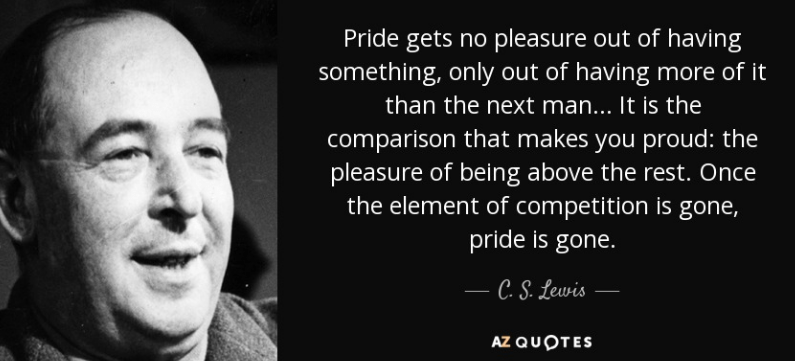
Ezra Taft Benson mentioned, “In the words of C. S. Lewis: ‘Pride gets no pleasure out of having something, only out of having more of it than the next man. … It is the comparison that makes you proud: the pleasure of being above the rest.” He goes on to say, “Pride is ugly. It says, ‘If you succeed, I am a failure’” (Benson, 1989).
Even more depressing is when we include pride in our marriages. Benson cautions that prideful individuals tend to refuse forgiveness and hoard grudges. Who wants to be married to a grudge holder? You would literally never be good enough for that person because even if you did repent and ask for forgiveness, it would be met with refusal and resentment. No, thanks.
However, no one is immune from giving or receiving such treatment included with pride. According to H. Wallace Goddard, “The natural man is inclined to love himself and fix others.” He goes on to mention, “When we are feeling irked, annoyed, or irritated with our spouse… we are guilty of pride” (Goddard, 2009, p.69). Did you catch that? It was simple to envision a grudge-holder and inwardly say, “That’s not what I do. That person needs to snap out of it.” It’s quite another to admit pride is the same as being irritated with your spouse. #OhSnap #Guilty
Benson hit that straight on when he said, “Pride is a sin that can readily be seen in others but is rarely admitted in ourselves” (Benson, 1989). How many times have I noticed the pride in my own husband, and others, while denying my own sin? I don’t want to comment on that. But I will share a story about a conversation I had with an aged woman at church. We’ll call her Mrs. Manners to keep it anonymous. The story went like this:
Mrs. Manners loved for children to be seen and not heard. She wanted nothing more than obedience and reverence when it came to the children’s church meeting. But as for me, I wanted the children to let their wiggles out. These little ones were tired, and after sitting still for the previous 2 hours all they really needed was pizza, ice cream, and possibly a pool party. (Unfortunately, we don’t swim in Sundays).

There I was, feeling sorry for these children even though they were managing to sit quiet fairly well, when Mrs. Manners stopped the class and in front of all the children belittled them for their rowdiness. Wait, what? Oh, no! You did NOT just reprimand these kids when they were doing the best they could to be noiselss.
After the meeting was over, I pulled Mrs. Manners to the side and let her have it. I was so angry I trembled as I pointed my finger at her, accusing her of saying horrible things to children, most of whom were mine, and at church. Jesus would never! What a sad excuse for a leader and teacher. I told her I would not stand for this type of treatment and she better shape up.
After dusting off my hands and hoping in the car to calm my nerves down, I went about my week. And wouldn’t you know: I found myself yelling the exact same horrible things to my children as Mrs. Manners had done the Sunday before. I was shocked at this revelation. I was totally embarrassed and humiliated. Benson’s words rang true that week, “The proud do not receive counsel or correction easily” (Benson, 1989). He is right. It wasn’t easy, it was demeaning.
In order to live with myself, I had to apologize. The following week I pulled Mrs. Manners aside, again, and let her know about my own actions and how terrible I felt for such hypocrisy. Then she did something that changed our relationship forever, she quickly forgave me with a smile, twinkle in her eye and a squeeze of my hand. All contention melted away in that moment, ceasing to return. Praise the Lord she was not as prideful as I was!
So, what’s the point? Pride will suck the happiness out of you. It will leave you hopeless, friendless, and depressed. It isn’t worth it. The opposite of pride is love, humility, and compassion. Goddard said, “Love is not a happy accident: It is a choice” (Goddard, 83).
If you’re like me, and know you have a constant internal battle with pride, try following Benson’s seven steps for pride repellent:
- Esteem others as yourself
- Receive counsel and chastisement
- Forgive those who have offended you
- Render selfless service
- Serve missions and preach the word that can humble others
- Attend the temple frequently
- Love God, submit your will to His, and put Him first in your life
Benson promises that as we are vigilant in conquering pride with these steps, we will be yielding our souls to God and becoming more capable of fulfilling our divine destiny. Such divinity has only room for love and compassion.
-Mrs.
Reference:
Goddard, H. Wallace (2009). Drawing Heaven into Your Marriage: Eternal Doctrines That Change Relationships. Utah: Joymap Publishing.
Ezra Taft Benson (1989, April). Beware of Pride










 Love and Marriage