Roots and Wings

Parenting is awkward.  My husband and I fake our way along this path.  We like to think we’re providing the best environment in our home for children to thrive, but there are intense moments where we scratch our heads, try new approaches, and ultimately fall to our knees in bewilderment.  We are constantly praying the Lord might ease the pains we may have inflicted both on purpose and unintentionally.

When we take a step back from parenting, there is the exciting reality that our children will not be in our homes forever.  #PraiseTheLord  They will eventually move out, and is that not the purpose and goal of parenting?  To guide small children through their teen years and then successfully launch them into adulthood?

Family therapists James M. Harper and Susanne Frost-Olsen counsel that parents are to provide their children with two things: roots to grow and wings to fly (Harper &Olsen, 2005).  The roots teach children who they are and where they came from and the wings inspire them to leave, move on and find their own place to plant roots of their own.  As parents foster healthy relationships with their children, they can feel a close bond without being physically present.  This is referred to as becoming emotionally secure (Harper & Olsen, 2005).

The best situation for emotional security to prevail in a family is for parents to first be united.  As my husband and I work to strengthen our own marriage our children will feel that bond we share spread out to include them.  Hopefully, as they become college students, adults, and young married couples we can continue to support through example more than words of criticism, threats or demands.  Harper and Olsen share that the best things parents can do for their young adult children is to provide a place where our children can safely express their concerns or worries without fear of condemnation or rejection.

As I think about this counsel I am reminded of my own early years in marriage.  What a nightmare.  Figuring out how to please divorced parents and new in-laws was enough to give me a nervous breakdown.  As time passes, I still feel self-imposed pressure to create love and happiness everywhere I go, but I am less concerned with making a family dinner or Christmas morning tradition that is not my own.  It would have been nice to take this class as a newly married, the pressure alone would have decreased, but what I can do is be the mom and future mother in-law that allows my grown children to make their own decisions minus the disappointment and criticism.  I can create an emotionally safe place for my children to express freely their ideals and wants for their own families.

-Mrs.

Harper, J. M. & Olsen, S. F. (2005). “Creating Healthy Ties With In-Laws and Extended Families.”
Life Cycles/Stages, Family Rules and In-Laws

In his book, “Till Debt do us Part”, Poduska taught about the important of marriage cycles or stages of married life. This is not new to anyone. We have all heard and experienced being newlyweds or a family with young children. We have also heard about empty nesters and everything in between. What I thought was interesting was the emphasis that each of these cycles have on a couple and how their relationships develop or suffer from these stages in marriage. It was most important to me, the portion of a marriage with young children and teenagers. This is a hard and difficult road. It is filled with joy and sorrow on a daily basis. What struck me most was the relationship between a husband and wife sometimes gets strained due to relationships that are forged between parent and child or parent and in-law. These are important relationships until they are placed before the relationship between spouses. This was a great wake up call to me to remember to be watering the grass on my side of the fence so I can maintain a healthy and lush lawn.


Family rules are a funny topic to me. The fact is that it is true that when you marry you bring baggage. This can be good quality luggage or can be a black trash bag that we somehow picked up in our travels. We bring our personal differences and unspoken rules that we sometimes don’t even know we have until something triggers them. These unspoken rules need to be discussed. Most importantly, they need to be discussed with an open mind with the knowledge that each partner in the relationship brings rules they deem to be normal that are foreign to the other. With this knowledge, we can work through the differences we are bringing to the partnership.


Understanding In-Laws! This could take an entire marriage to do. I learned from both Poduska and from Harper and Frost Olsen that the in-laws want to be a big part of their children’s lives. Most of what they say or mean are gestures of help or support. A big part of my learning this week was that opinions and differences are a big part of frustration and problems involving in-laws. Keeping this in mind and expressing gratitude and patience toward in-laws can do wonders in a relationship.

Power Relationships, Councils and Being One

In his paper, “Who is the Boss? Power Relationships in Families”, Richard B. Miller shared about the dynamics of power struggles and the influence these power struggles have on families. This article was definitely for me this week. I was humbled to see the effects of power relationships. I feel that I have some work to do in order to cut out some of these harmful practices. It is interesting to see things from a different perspective. Often you do not see your own faults until it is too late or until it is presented in just the right light to set off a guided thought process. I approached my wife about power relationships and was reminded of certain actions that are a part of my daily schedule. This sent me reeling and thinking of what I need to do in order to correct some of my behavior. I pray and hope that I can focus on these things in order to make some changes for the betterment of my relationship with my spouse and with my children.


In Elder Ballard’s book, “Counseling With Your Councils” he talked about the importance of councils and most of all the importance of listening. I felt the impression of listening with an open mind and not trying to force your opinion or will upon those whom you are counseling. I often get so excited about something and try to convince everyone around me of how grand the idea will be. I need to stop this and take into consideration everyone else’s mindset of the situation. It was great to hear of how in a true council there is no pushing ones agenda on others and that it can all be resolved by asking for higher help and seeking guidance of the Holy Ghost.


President Henry B. Eyring gave a conference address in April of 1998 that emphasized the importance of being one with our Heavenly Father. When we are one with the Father, we can be better stewards of our responsibility as a spouse and a parent. The Holy Ghost is a sanctifier that can help us become one with our spouse. Unified marriages are strong and teach children the correct way to work as a team with the blessings of heaven close to hand an in sight.  “It is our surrender to the Lord Jesus Christ that allows us to be bound as families” (Eyring, That We May Be One, 1998 April). In serving one another we can be true disciple of Jesus Christ and our Father. This will help us be happier and keep the focus on what is truly important in this life.

Side by Side

Powerhouse couples.  You know, the husband and wife that seem to be rock stars, solid, and to genuinely enjoy each other’s company?  What makes some couples stand out as strong and immoveable while others appear to be lazily going through the motions?  The answer: unity.

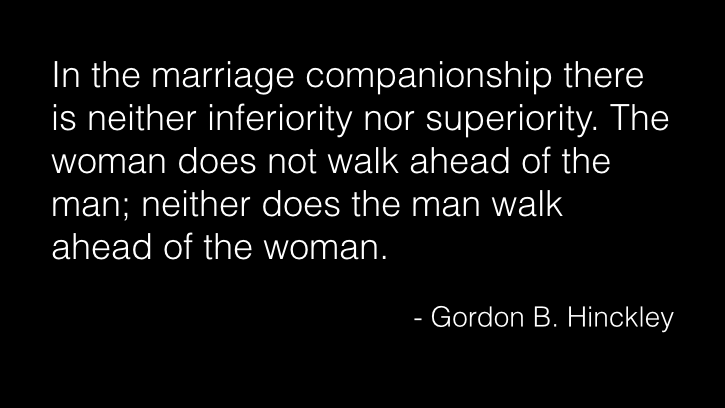
Wise counsel from a modern prophet, stated, “In the marriage companionship there is neither inferiority nor superiority. The woman does not walk ahead of the man; neither does the man walk ahead of the woman. They walk side by side as a son and daughter of God on an eternal journey.  She is not your servant, your chattel, nor anything of the kind.” (Hinckley, 2002).

Screen Shot 2018-12-06 at 7.30.34 PM

“Side by side” is critical in a united couple and yet so complicated to achieve.  Elder Henry B. Eyring warned, “With the Fall it became clear that living in unity would not be easy” (Eyring, 1998) and he is right.  Anyone who has ever attempted to be at peace with those around them has run into resistance.  Applying that principle to marriage can be especially daunting as it is our human nature to compete and compare with each other.  This competition is referred to as pride.

What resources do we have to battle pride?  We have the Spirit and our choice to invite the Spirit into our hearts and marriage.  Eyring counsels:

“The Spirit only dwells with those who choose the Lord over the world… Where people have that Spirit with them, we may expect harmony… The Spirit of God… never generates the feelings of distinctions between people which lead to strife (see Joseph F. Smith, Gospel Doctrine, 13th ed. [1963], 131). It leads to personal peace and a feeling of [unity]” (Eyring, 1998).

We have the power to choose unity or isolation in our marriage relationships.  Each time we choose forgiveness over grudge holding, compassion over harsh words, and kindness over degrading comments we are becoming united.  I hope to consciously choose “the Lord over the world.”  In my case, it would be the Lord over pride.

-Mrs.


Reference:

Eyring, Henry B. (1998, May). That We May be One, Ensign

Hinckley, Gordon B. (2002, May). Personal Worthiness to Exercise the Priesthood, Ensign

Seeds of Lust

“President, you’ve got to transfer me out of here.  My district leader is so hot, it’s difficult for me to focus on the work!”

“Can you hold on for the rest of the week, Sister?”

“I hope so.”

“Okay, I’ve got just the place for you.”

“Thanks, President.”

This was a real-life phone call I made to my mission president while serving for a few transfers in the Arkansas Little Rock Mission.  I was on leave from Temple Square to experience “field time” and it didn’t take long for me to understand why the Lord had called me to Temple Square in the first place.  It’s the only mission in the world where there are no young Elders. Just sisters and senior couples.  I didn’t realize until I was shipped out to Arkansas that handsome young men could be my downfall.

Screen Shot 2018-12-01 at 8.45.49 PM

Photo Source

And my mission president wasn’t kidding about the “place” he had for me to take my mind off boys and back to the work I was there to do.  I was transferred to a district with the shortest, goofiest looking Elders I had yet to serve with and I was grateful for it. I had no distractions and could focus on missionary work the rest of my service there.

When it was time for me to transfer back to Salt Lake City from Arkansas [to finish out my mission] I was transported to the mission home with President and his wife.  As I slipped into the back seat of their car, President mentioned, “Hey, Sister.  Pick the hottest Elder out there and I’ll let him ride in the car with us back to Little Rock.”  “Really?!”  “NO!” he responded as he heartily laughed.  “You are still a missionary.  Good grief, get in the car and stop looking at the Elders!”

What if I hadn’t called my mission president?  What if I allowed innocent relationships to blossom during my mission?  Even if the Elder hadn’t reciprocated the feelings I was beginning to have toward him, how would the next 12 weeks have been if I was constantly thinking about a handsome young man, and lost the focus on my purpose as a missionary?  I don’t want to know.

Goddard shares a list of guidelines to help people stay out of trouble.  Though he is talking about relationships with the opposite sex when a person is married, the items in this list were a red flag for me so many years ago as I was a full-time missionary.  Goddard’s suggestions include:

• Do not allow the seeds of lust to germinate.

• Never make excuses to spend time alone with a person of the opposite sex who is not your spouse.

• Do not allow your heart to dwell on anyone

• Don’t set yourself up for failure

There was much more in his counsel that pertains to clinging and spending time and energy on your spouse rather than other people or hobbies that exclude them.

I am now married to an incredibly attractive man.  We are growing together, but it is nice to be reminded to make an effort for us.  For me to go out of my way to interact with my spouse and shun any other practice that might unhealthily draw my attention elsewhere.  I hope to find ways to be intentional about loving my husband.

-Mrs.

The Sanctity of Sexuality

Learning of the sacred responsibility of procreation and the responsibility of knowing our spouses at a higher level is important for every marriage. Fortunately for me my spouse has no problems talking about the nature of intimacy or sexuality. This is funny to me because of my upbringing. My upbringing is no doubt similar to many others who have grown up in the Church of Jesus Christ of Latter-Day Saints. In my family, I didn’t hear anything about the nature of procreation and or the sacred powers that come from sexuality ordained of God. It was taboo. We just didn’t talk about it. This is unfortunate, especially when I realized right before my wedding, that I dint know squat about something that is deemed sacred and a great importance of why we get married. Unfair and a disservice I say. I grew up thinking that anything within the nature of the sexual realm would land me into trouble with an interview with the Bishop. Don’t get me wrong this helped me steer clear of anything of the nature. It is a great scare tactic. Unfortunately, it created a healthy case of ignorance for something that is blessed and sanctified of God. Throughout the scriptures we learn that God wants us to have a knowledge of sexuality and wants us to fulfill his commandments of having children and to care for our spouse. This is a beautiful and great responsibility we have been charged with. As in our nature we often give less attention to these commandments and forget our responsibilities. I hope to remember this and become a better steward to my spouse and give her the attention and focus she deserves. On another note, I need to prepare my children for the responsibility they will hold someday. As parents, it is our responsibility to prepare our children for adulthood. Teaching them doctrine about the importance of procreation and the responsibility one has as a marriage partner will help them understand the beauty of what marriage and sexuality can be in the right circumstances. I would have liked a bit of a heads up myself. It will be much better to know that marriage is a sacred union and certain commitments are blessed and accepted by God rather than, sex is bad, bad, bad, and then all of the sudden it is ok. I am a black and white type personality and I had some difficulty with this step in marriage.

Thankfulness

When we’re angry our true colors show in painful clarity.  “What a man does when he is taken off his guard is the best evidence for what sort of a man he is.  Surely what pops out before the man has time to put on a disguise is the truth” (Goddard, 2009, p114).  Was I the only one who immediately scanned their past heated outbursts after reading that?  What is my true nature?  Am I a monster cleverly masked as a compassionate wife and mother?  I hope not, but I never can be sure as I view myself and my actions with rose colored lenses.

However, there are times when I get a glimpse of myself that seems true, yet is tainted with unhappiness.  Whether I’m sharing it intentionally or not, I can be a little too frank with my husband at times.  I don’t notice my harsh words until they have spilled over my lips and filled the air.  I may not mean them the way they are received, but it doesn’t change their effect.  Negative.

Gottman shares that there is a good 20% of our spouses that will be either irreconcilable differences or just irritating to us.  The trick is to focus on the 80% and the key: thankfulness.  One way Gottman encourages us to battle a negative disposition and outlook on our spouse is to find qualities to be thankful for in them.  If I understand that correctly, sharing gratitude for our spouse really makes a difference for the better.  Gottman counsels that as we practice thanksgiving, “You’ll receive a great gift: You will become less critical of yourself” (Gottman, 1999, p284).

Screen Shot 2018-11-24 at 7.36.29 PM.png

Photo Source

Not only will we become less critical of self, but we will be aware of the great talents and blessings our loved ones have to offer.  Focusing on the positive weeds our souls of contempt and darkness.  What a beautiful time of year to begin focusing on thanksgiving and kind things to say to, and about, our better halves.

-Mrs.

References:

Goddard, H. (2009). Drawing Heaven into Your Marriage. Utah: Joymap Publishing.

Gottman, John M. and Nan Silver (1999).  The Seven Principles for Making Marriage Work. New York: Harmony Books.

Dreams

What are dreams made of? This week, reading The Seven Principles for Making Marriage Work helped me understand that dreams, or life-long goals, are deeply seeded from our upbringing or a result of something experienced somewhere along the road of life. He suggested to look for and listen to your partners dreams. In becoming a “dream detective” (Gottman, 1999, p244), we can better understand where some underlying feelings, fears or hang-ups are coming from. This can help us negotiate or create compromises that will help our marriages in the long run.

While doing the suggested exercise in the book this week I was able to work through some hang-ups that I was not aware of. These are things that I didn’t understand why they were important to me until concentrating on them, with the help of my spouse.  I was also able to understand a little more of why my spouse reacts to some of the things that I do. These came from a perpetual conflict that bares its head every so often. The problem itself may never go away, but I can now understand why the reaction occurs. I don’t need to take it personally and can better help alleviate the damage when it occurs.


In his book, Drawing Heaven into Your Marriage, Goddard asks readers to focus on the Savior’s invitation to come unto Him and to have charity. This alone will increase the love and care one has for their spouse and thinking about it has helped me understand how much my spouse has charity for me. It’s not even fair. Here I am trying to become better to my spouse and I realize that she more loving than I deserve. Goddard gives the example of John Glenn’s devotion to his wife who has a stuttering problem. This problem was not a problem to John Glenn and he loved his wife anyway. It is an excellent example of how focused and supportive one should be toward their spouse. There is a lot of work to do in order to become a better and more charitable spouse. I hope to have a greater focus and to support my spouse. I know this will help me become the husband and father my wife and children deserve.

Perpetual or Solvable

Marital issues can be grouped into two categories: A perpetual problem, with no solution, or a solvable problem.  Solvable problems are much easier to resolve when you have the desire to work through them. For example, my wife and I have an ongoing disagreement about household chores. It is not fair that my wife is home all day and faced with a house full of gremlins (children) that undo any form of cleaning. Often, we talk about how I can pick up some of the slack. Normally it is a no brainer and I help immediately, but messes are a constant in our home making this an ongoing-solvable problem.  Easy enough.

But let me chime in on the driving issue the Mrs. so cleverly outlined. I normally drive when we go on long trips; I like to be aware of my surroundings. This means I am always looking in the distance of things around me. I often notice what others may not. In my observations of the beautiful surroundings, I might hit the rumble strips on occasion. I know this, and I am also aware that it really bothers the Mrs. I understand it is noisy and uncomfortable at times, but I don’t do it on purpose and not once has anyone been hurt. Yet it normally begins an emotionally filled discussion about how unsafe and irresponsible my driving habits are. I get defensive and give her the opportunity to drive if it would make her feel safer.  When I stop to think about it, this simple and petty issue keeps coming up letting me know this is the eternal perpetual problem.

In his book, John M. Gottman gives us a few steps to remember when dealing with marital conflict. These steps are:

  • Negative emotions are important
  • No one is right
  • Accepting is crucial
  • Focus on Fondness and admiration

These steps seem simple enough and taking them will help us work through issues.  Together we can come to understand each other and diffuse any anger or resentment before it ruins our relationship (Gottman, 1999, p157).

Shifting gears, while reading Drawing Heaven into Your Marriage by H. Wallace Goddard, I really enjoyed how he put such an emphasis on the importance of living with the attitude of consecration with your spouse. The willingness to live by this higher law will help us have a much closer relationship with our spouse and is preparing us to live a life that our Heavenly Father and Jesus Christ are preparing for us in the life to come. We can live and move as one instead of two halves. I think of this and tell myself I have a way to go yet but can have a hope to get there. I know that if anyone can help me get there it will be with the help of the Lord and my wonderful spouse, whether in the car or in the home. This is a lofty goal but why not shoot for the moon and hit a star? The worst that could happen is that we miss and then try again and again.

-Mr.

Screen Shot 2018-11-15 at 3.04.49 PM

Photo Source

References:

Gottman, John M. and Nan Silver (1999).  The Seven Principles for Making Marriage Work. New York: Harmony Books.

Goddard, H. (2009). Drawing Heaven into Your Marriage. Utah: Joymap Publishing.

Driving With the Mr.

Ka-klunk, ka-klunk, ka-klunk, ka-klunk, the sound penetrated my head, causing my brain to be jarred from its comfortable resting place.  As my teeth chattered with each dip of the car, I quickly became irritated that my husband was incapable of driving inside the designated lane on the freeway.  Oh my gosh, he never pays attention to the road when driving.  Instead he scans the landscape for potential hunting spots or wandering bucks.

He remained on the broken line of the road, a few seconds longer than necessary, only to sway the other direction hitting the zipper on the far-right side of the freeway.  Justin forced that medium pitched hum to permeate the vehicle, raising the noise level a handful of decibels and that was it!  I couldn’t take the inconsistency of car management anymore.

Screen Shot 2018-11-15 at 1.14.54 PM

Photo Source

“Please, let me drive!” I demanded, not even attempting to remain calm.  “What? I was looking at something,” he responded, irritation rising in his tone.  “It’s not hard to stay in the middle of the lane.  I can’t stand riding in the car with you,” I criticized.  “It’s not that bad, it’s called driving by brail,” he humored, trying at a repair attempt.  I wasn’t having it. “Why don’t you trust me?  I’m a trained professional!” he escalated, meeting my anger and rising to a new level.  “This isn’t about trust, it’s about safety.  You mimic a drunk driver when you swerve from one side to the next.  You almost hit that car a minute ago and I don’t feel safe.  Please pull over, you’re done driving!” I commanded.  This only led to flooding on his part, “Every time we get in the car you always criticize my driving.  I drive for a living, it’s my career, why won’t you trust me?  You haven’t been trained the way I have behind the wheel,” he said, anger flashing across his face.  Knowing there was no way out of this conversation, he finally decided to change his role from defense to offense.  “Fine, you drive the rest of the way.  I’m never driving again,” he responded, with an immediate stonewall once in the passenger seat.

For all the marriage problems we avoid, the Lord had to allow a few imperfections to come our way, driving is definitely one of them.  The irony: he really is a highway patrolman and does drive for a living.

Screen Shot 2018-11-15 at 1.20.35 PM

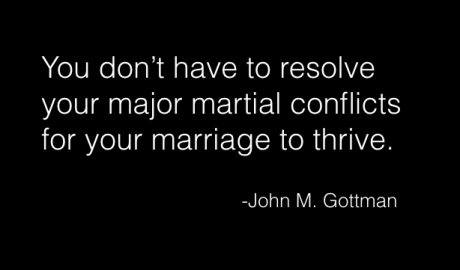
Early in Gottman’s book he mentions that not all problems are solvable in marriage.  Thank you, Jesus, for inspiriting John Gottman to write this book!  My whole marriage I have tried to conquer this conflict over driving with Justin and it doesn’t work.  I immediately shared with my husband that not all problems are solvable in marriage and we both smiled, looked at each other and said, “driving.”  We didn’t need to check with one another, we know our biggest struggles.  We’ve known for 15 years.  What a relief to learn, “You don’t have to resolve your major marital conflicts for your marriage to thrive” (Gottman, 1999, p139).

-Mrs.


Reference:

Gottman, John M. and Nan Silver (1999).  The Seven Principles for Making Marriage Work. New York: Harmony Books.